
Home / Practice Areas / Notary & Commissioning Services
NOTARY & COMMISSIONING SERVICES
Notary &
Commissioning Services
Professional document services, handled clearly and efficiently.
Looking for a notary public in Toronto? Trusz Law provides notary and commissioning services for individuals, families and businesses, including affidavits, certified true copies, immigration-related documents and other legal documents.
Requirements vary by document and by the organization receiving it. We help you understand what service is being requested, what to bring and what happens at the appointment.

Bring the document. Bring the instructions.
We will help make the next step clearer.
The right service depends on what the document requires.
Some documents need a signature witnessed. Others require an oath, affirmation or declaration. A receiving organization may ask for a certified true copy or another specific form of notarization.
Start with the instructions from the receiving organization
A notary or commissioner does not decide what another government, court, school, employer, bank, consulate or organization will accept. The safest starting point is the exact instruction you received.
In Ontario, a commissioner for taking affidavits can take affidavits and administer oaths, affirmations or declarations. A notary public has those powers and may also verify signatures, marks and copies of documents as true or genuine.
Trusz Law helps identify the service requested and complete the notarial or commissioning step within the scope of the appointment.
PREPARE FOR YOUR APPOINTMENT
What should you bring to a notary appointment?
Preparing the right documents in advance can make the appointment faster and reduce the chance that you need to return.
01
The complete document
Bring the full document and any instructions from the organization requesting it. Avoid signing in advance when the signature must be witnessed.
02
Valid identification
Bring current government-issued identification appropriate to the service and document requirements.
03
The original, when a copy must be certified
A certified true copy generally requires comparison with the original document. Bring the original rather than only a photocopy.
04
Any special instructions
Bring forms, checklists, embassy or consulate instructions, court directions, application guidance or wording required by the receiving organization.
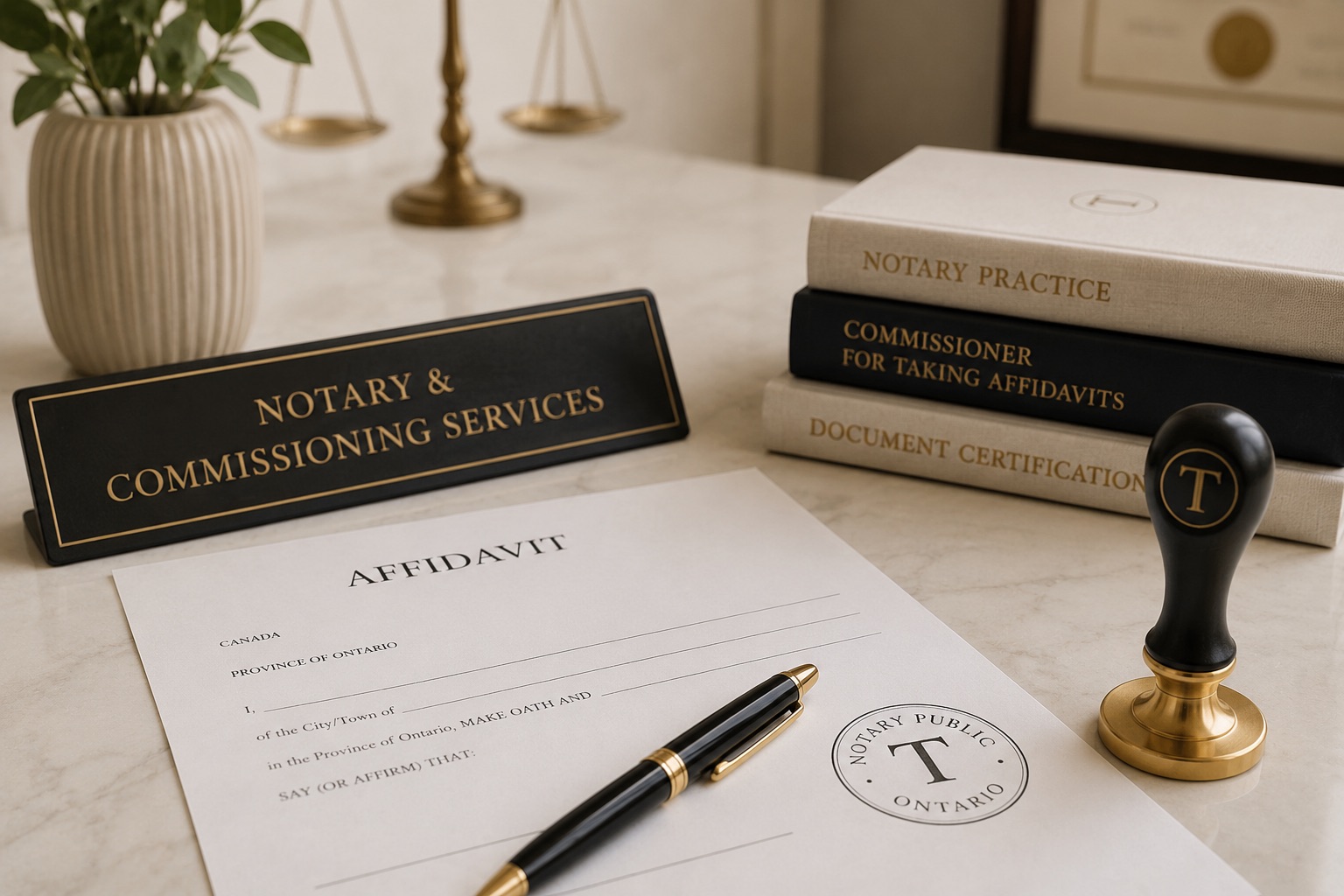
NOTARY & COMMISSIONING SERVICES
How we can help
This page is the main notary-services hub for Trusz Law. Each service below links to a focused page with more detail about the document type, appointment and common requirements.
01
Notary Public Services
Notarial services for documents requiring a notary public, including witnessing or certifying document execution and other services within a notary’s legal authority.
02
Commissioning of Affidavits
Commissioning for affidavits, statutory declarations and other documents requiring an oath, affirmation or declaration.
03
Immigration Document Notarization
Notarial and commissioning services for immigration-related documents when the applicable application or receiving authority requires a notarized document, certified copy or sworn translation affidavit.
04
Certified True Copies & Legal Document Notarization
Certification of copies and notarization of legal documents where the recipient’s instructions call for those services.
UNDERSTANDING THE DIFFERENCE
Notary public or commissioner for taking affidavits?
The document or receiving organization may specify which one is required.
Commissioner for taking affidavits
A commissioner can take affidavits and administer oaths, affirmations or declarations. This may be the service requested when a person must swear or affirm that the contents of a document are true.
Notary public
A notary public has the powers of a commissioner and may also verify that signatures, marks and copies of documents are true or genuine. The appropriate service depends on the document and recipient’s requirements.
A SIMPLE APPOINTMENT PROCESS
From requirement to completed document
Notary appointments are usually straightforward when the correct documents and instructions are available.
01
Check the requirement
Review the instructions from the organization receiving the document and identify whether it asks for notarization, commissioning, a certified copy or another specific step.
02
Prepare the documents
Bring the complete document, appropriate identification, original documents where copies must be certified and any required instructions.
03
Complete the appointment
The document is reviewed for the requested service, identity and originals are checked as applicable, and the notarial or commissioning step is completed.
04
Confirm any next step
Some documents—especially those for use outside Canada—may require authentication, an apostille, translation or another process after notarization.
COMMON DOCUMENT NEEDS
Documents people often bring to a notary
The exact service depends on the document and the requirements of the organization receiving it.
Affidavits & statutory declarations
Documents requiring an oath, affirmation or declaration before an authorized person.
Certified true copies
Copies that must be compared with an original and certified as true copies where the recipient accepts this form of certification.
Immigration-related documents
Documents connected to immigration or citizenship processes when the exact application instructions call for notarization, certification or a sworn translation affidavit.
Travel, education & employment documents
Documents requested by schools, employers, professional bodies, governments or other organizations.
Business & corporate documents
Documents used in business, banking or corporate matters where notarization, witnessing or certification is requested.
Documents for use outside Canada
Canadian documents that may require notarization before a separate authentication or apostille process.
NOTARY SERVICES IN TORONTO
Efficient service without guessing what your document needs.
Trusz Law provides notary and commissioning services from its Toronto office for clients who need documents witnessed, commissioned, certified or notarized.
For immigration and international document use, requirements can be especially specific. A notarization may be only one step. Depending on the destination and document, a separate apostille or authentication process may be required after notarization.
The fastest way to prepare is to bring the exact instructions from the organization, country, consulate or application receiving the document.
FREQUENTLY ASKED QUESTIONS
Notary and commissioning FAQs
General information about common appointment questions. The receiving organization’s instructions remain important.
What is the difference between a notary public and a commissioner for taking affidavits?
In Ontario, a commissioner can take affidavits and administer oaths, affirmations or declarations. A notary public has those powers and can also verify signatures, marks and copies of documents as true or genuine.
Should I sign my document before the appointment?
Do not sign in advance when the signature must be witnessed or the document must be sworn or affirmed in front of the authorized person. If the instructions are unclear, bring the document unsigned.
What is a certified true copy?
A certified true copy is a copy that has been compared with an original document and certified by an authorized person in the form required or accepted by the receiving organization.
Can you notarize immigration documents?
Trusz Law can provide notarial or commissioning services for immigration-related documents where the applicable instructions require them. Requirements vary by application, and some processes require originals or specific types of copies instead.
What is an affidavit?
An affidavit is a written statement of facts that a person swears or affirms to be true before someone authorized to administer the oath or affirmation.
Do I need a notary or a commissioner?
Check the document instructions. Some organizations specifically require a notary public, while others accept a commissioner for an affidavit or declaration. Bring the instructions if you are unsure.
What identification should I bring?
Bring current government-issued identification appropriate to the document and service. The exact identification requirements can depend on the document and circumstances.
Do I need to bring the original document for a certified true copy?
Usually, yes. The authorized person generally needs to compare the copy against the original document before certifying it as a true copy.
Can a notary certify documents for use outside Canada?
A notary may be able to notarize a document or certify a copy, but international use may require additional steps. Depending on the document and destination, an apostille or authentication process may also be required.
How should I prepare for my notary appointment?
Bring the complete document, the exact instructions from the receiving organization, appropriate identification and original documents where copies need to be certified. Avoid signing in advance when witnessing is required.
Helpful public resources
For general public information about notaries, commissioners and documents for use outside Canada:
Bring the document. We’ll help with the next step.
Book a notary appointment and bring the document, your identification, any originals that need to be copied and the instructions from the receiving organization.
General website information is not legal advice. Acceptance requirements are determined by the organization receiving the document.